📅 Overview Post | Global AI Superpower Series
Based on Stanford University’s AI Index 2025
Introduction
The AI Index Report 2025, published by Stanford University’s Human-Centered AI Institute (HAI), offers a comprehensive, data-driven snapshot of the global artificial intelligence landscape. With over 500 pages of charts, analyses, and comparative metrics, the report covers developments in AI research, development, governance, and impact across the world. This year’s edition places special emphasis on frontier model performance, cost-efficiency, geopolitical trends, talent movement, and open-source contributions.
🔍 Key Findings
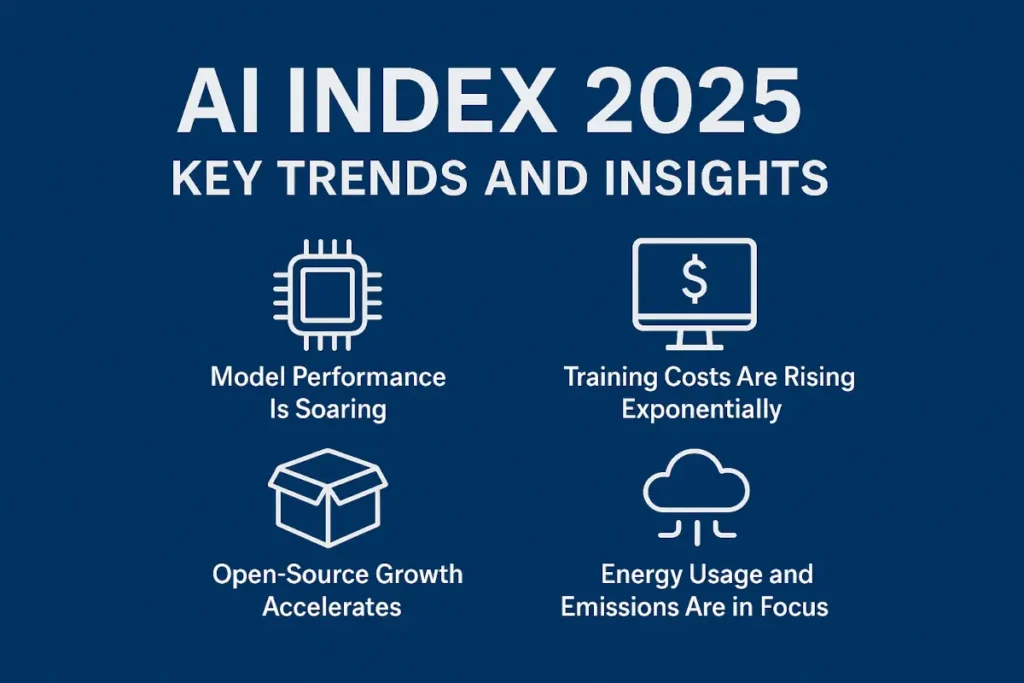
1. 📈 Model Performance Is Soaring
Frontier models like GPT-4, Claude 3, and Gemini 1.5 are now outperforming human experts on a wide range of academic and reasoning benchmarks, including:
-
MMLU (Massive Multitask Language Understanding)
-
HumanEval (coding)
-
HellaSwag & Winogrande (common sense reasoning)
The average performance improvement over last year’s top models is significant—some benchmarks show 20–30% accuracy gains in just 12 months.
2. Training Costs Are Rising Exponentially
Training frontier models is becoming more resource-intensive:
-
GPT-4’s estimated training cost: $78 million
-
Average GPU count: 25,000+ NVIDIA A100/H100 equivalents
-
Training time: several weeks to months
This trend reflects the growing infrastructure barrier to entry in frontier model development.
3. Open-Source Growth Accelerates
The number of open-source models increased by 70% in 2024. Top contributors include Meta (LLaMA series), Mistral, Hugging Face, and Cohere. While U.S.-based labs lead in citation count, European developers lead in model documentation transparency.
4. AI Research Output Expands Globally
AI research papers published in peer-reviewed venues grew 16% year-over-year, with China, the U.S., and the EU as top contributors. The top topics include:
-
Multimodal AI
-
Reinforcement learning
-
AI alignment and robustness
-
Language model evaluation
5. Energy Usage and Emissions Are in Focus
Frontier models now consume tens of megawatt-hours per training run. For the first time, Stanford included emissions data:
-
GPT-4 (est.): ~500 tons CO₂e
-
Emphasis is now on “Green AI” and efficient training protocols.
6. Benchmarks Are Diversifying
Traditional benchmarks are being supplemented with new ones like:
-
LMSYS Chatbot Arena (crowd preference)
-
Holistic Evaluation for Language Models (HELM)
-
TruthfulQA and BIG-Bench Hard
These measure truthfulness, safety, bias, and multi-turn reasoning—critical for real-world deployment.
Conclusion
The AI Index 2025 presents a world where AI is no longer experimental—it is infrastructure. Model quality, training efficiency, and responsible deployment are now more important than raw capability. For researchers, policymakers, and developers, this report acts as a dashboard of global AI health, offering clarity on where the field stands—and where it must go.